Treatment
Semaglutide dosage chart: Ozempic®, Wegovy® and Rybelsus®
September 26, 2026 · 7 min read
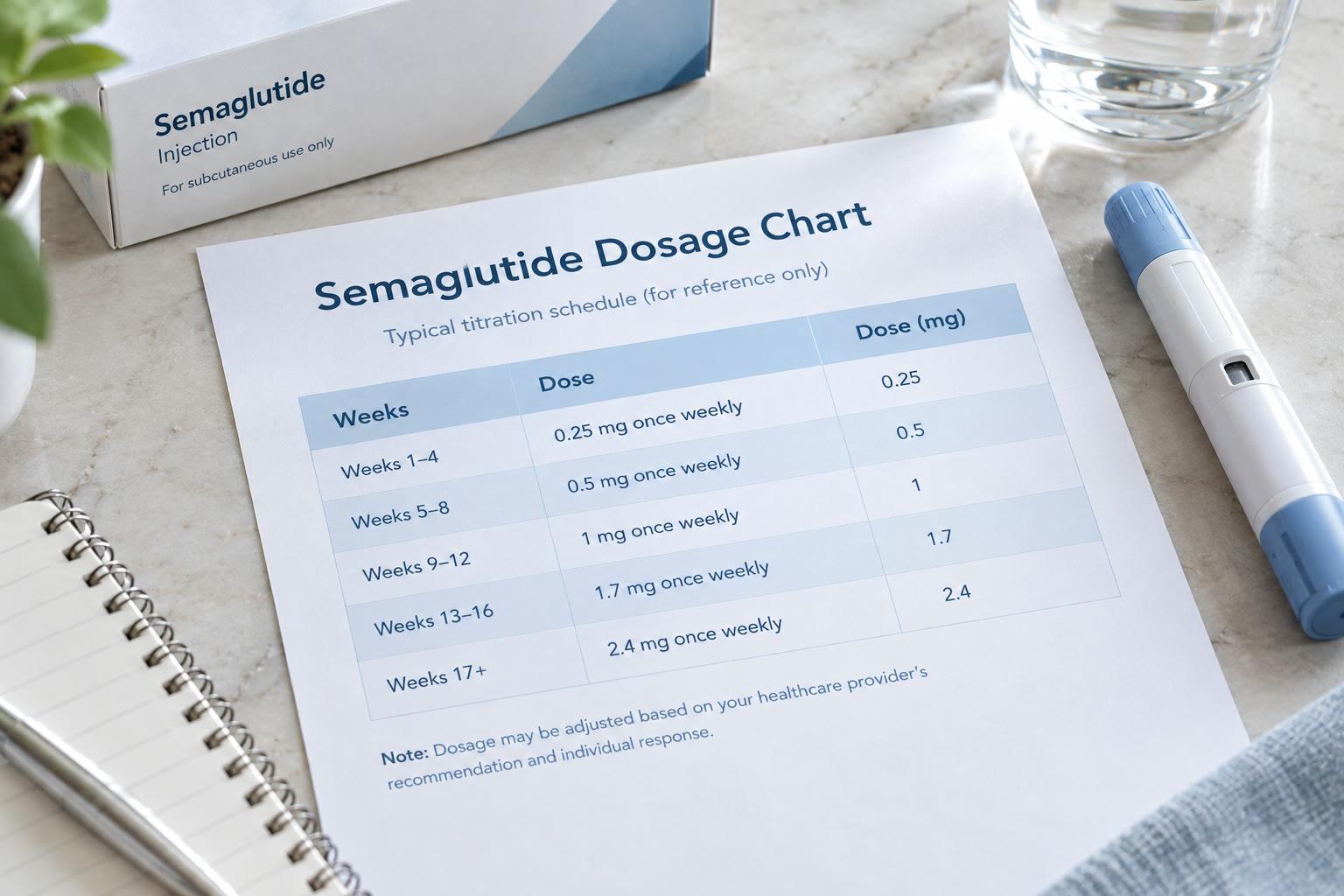
The three semaglutide schedules from the FDA labels: Ozempic® to 2 mg, Wegovy® to 2.4 mg, Rybelsus® tablets to 14 mg, plus maintenance doses and missed doses.
Semaglutide is sold as three FDA-approved products with three dosing schedules: Ozempic® and Wegovy® as once-weekly injections, Rybelsus® as a daily tablet. This chart restates each schedule from the labels, explains the starting dose, and says how compounded semaglutide differs. It describes the labels; your prescriber sets your dose.
What is the Ozempic® dosing schedule?
Ozempic® is approved for adults with type 2 diabetes. It starts at 0.25 mg once a week for four weeks, a starting dose meant to let the body adjust rather than to control blood sugar. It then moves to 0.5 mg. If more is needed after at least four weeks, the dose can rise to 1 mg, and after at least another four weeks to 2 mg, the maximum.
| Step | Weekly dose | Minimum time at this step | Notes |
|---|---|---|---|
| 1 | 0.25 mg | 4 weeks | Starting dose; not intended for blood-sugar control |
| 2 | 0.5 mg | 4 weeks | First maintenance dose |
| 3 | 1 mg | 4 weeks | If more is needed |
| 4 | 2 mg | Ongoing | Maximum dose |
What is the Wegovy® dosing schedule?
Wegovy® is approved for chronic weight management. It starts at 0.25 mg once a week and steps up every four weeks through 0.5 mg, 1 mg and 1.7 mg to a maintenance dose of 2.4 mg. The label allows 1.7 mg as a maintenance dose for someone who does not tolerate 2.4 mg.
| Step | Weekly dose | Minimum time at this step | Notes |
|---|---|---|---|
| 1 | 0.25 mg | 4 weeks | Starting dose |
| 2 | 0.5 mg | 4 weeks | Step |
| 3 | 1 mg | 4 weeks | Step |
| 4 | 1.7 mg | 4 weeks | Step; acceptable maintenance dose if 2.4 mg is not tolerated |
| 5 | 2.4 mg | Ongoing | Maintenance dose |
What is the Rybelsus® dosing schedule?
Rybelsus® is the semaglutide tablet, approved for adults with type 2 diabetes. It starts at 3 mg once a day for 30 days, a starting dose, then moves to 7 mg. If more is needed after at least 30 days, it can rise to 14 mg. The tablet is taken on an empty stomach with no more than four ounces of plain water, at least 30 minutes before the first food, drink or other medication of the day.
| Step | Daily dose | Minimum time at this step | Notes |
|---|---|---|---|
| 1 | 3 mg | 30 days | Starting dose; not intended for blood-sugar control |
| 2 | 7 mg | 30 days | First maintenance dose |
| 3 | 14 mg | Ongoing | If more is needed |
What is the semaglutide maintenance dose?
It depends on the product. Ozempic® is maintained at 0.5 mg, 1 mg or 2 mg a week; Wegovy® at 2.4 mg a week, or 1.7 mg if that is not tolerated; Rybelsus® at 7 mg or 14 mg a day. Within those ranges the prescriber decides, from how the person is doing and how they tolerate treatment.
What if a semaglutide dose is missed?
For Ozempic® and Wegovy®, the labels say to take a missed dose within five days of when it was due, and otherwise to skip it and take the next dose on the usual day; at least two days (48 hours) should separate any two doses, which is also the rule for changing the injection day. For Rybelsus®, a missed tablet is skipped and the next one taken the following day. If you take compounded semaglutide, the pharmacy's and your clinician's instructions take precedence; message your care team rather than guessing.
How does compounded semaglutide dosing differ?
The molecule is the same, but a compounded preparation is made by a licensed compounding pharmacy for an individual patient, and the dose is set by the prescribing clinician rather than by a fixed pen strength. Compounded medications are not FDA-approved and are not reviewed by the FDA for safety, effectiveness, or quality. At GLP, the Semaglutide Injections program steps the dose up on a schedule your clinician sets, the Oral Semaglutide program is a daily dissolvable tablet that is not Rybelsus®, and the Semaglutide Microdose Injection stays below the standard schedule on purpose.
This article is educational and is not a substitute for personalized medical advice. Whether any medication is appropriate for you is a decision for a licensed clinician who has reviewed your health history.