Treatment
Where to inject semaglutide or tirzepatide
September 26, 2026 · 6 min read
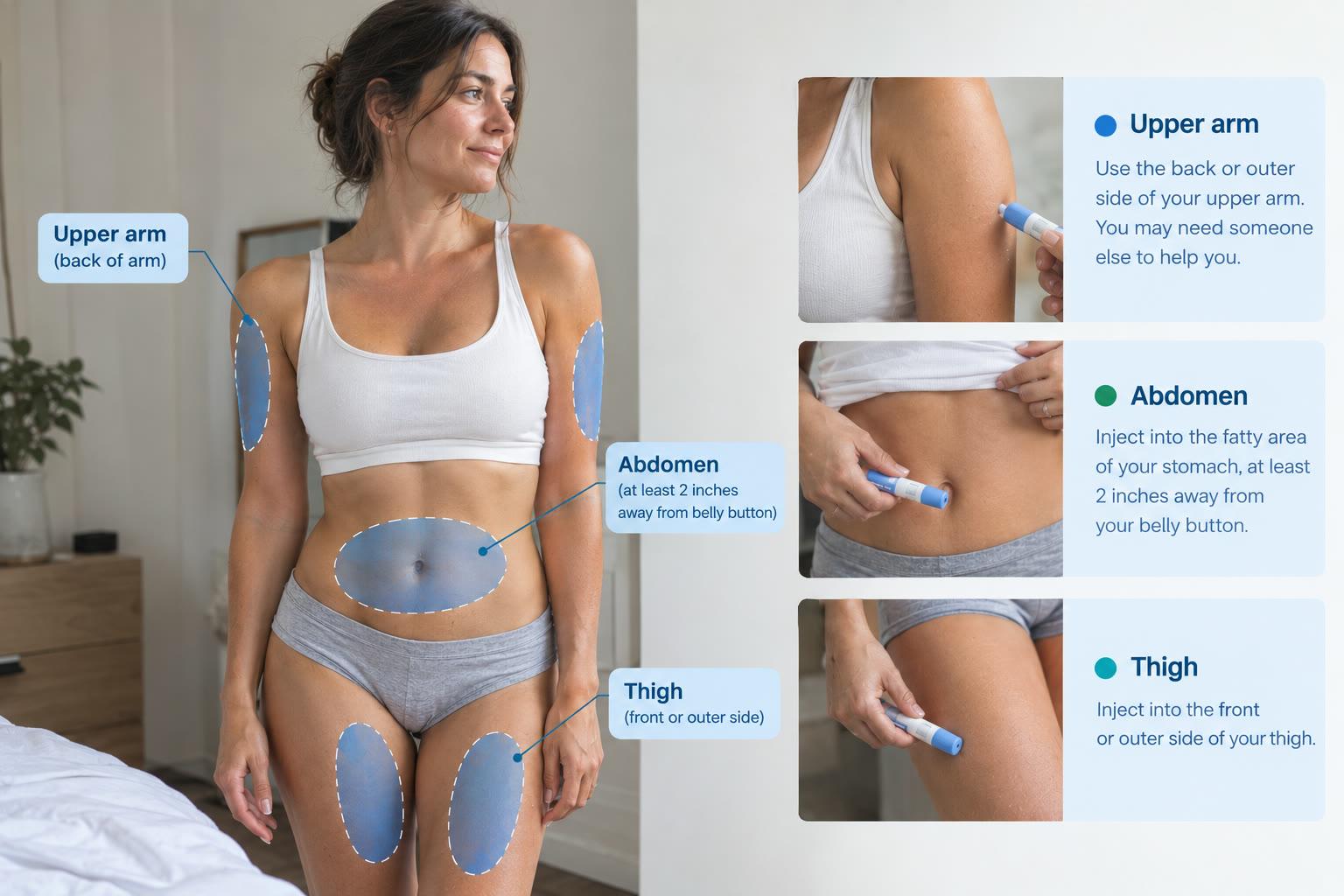
The three injection sites on the labels, how to rotate them, what day and time to inject, pens versus vials, and what an injection-site reaction looks like.
Every semaglutide and tirzepatide injection, brand-name or compounded, goes under the skin, and the labels name the same three places. This article restates them, explains rotation, and covers the questions people ask before a first dose. It is general information; the instructions that came with your medication and your clinician's directions come first.
Where can semaglutide and tirzepatide be injected?
- The abdomen, at least two inches away from the navel.
- The front of the thigh.
- The back of the upper arm, which usually needs someone else to do it.
The injection is subcutaneous, into the fatty layer under the skin, not into muscle. All three sites are on the labels for Ozempic®, Wegovy®, Mounjaro® and Zepbound®, and the labels treat them as equivalent.
Which injection site is best?
None of the three is preferred on the labels. Most people settle on the abdomen or thigh because they can reach them without help. Comfort, what you can see, and rotation matter more than which site you pick.
How do I rotate injection sites?
Use a different spot each week. You can stay in the same area, the abdomen for example, and move around within it, or alternate areas. Avoid skin that is bruised, tender, red, hard or scarred. Rotation is on every label because repeated injections in one spot can irritate the skin.
What day and time should I inject?
Once a week, on the same day each week, at any time of day, with or without meals. The labels allow the day to be changed as long as enough time has passed since the last dose: at least two days (48 hours) for semaglutide, at least three days (72 hours) for tirzepatide. If you take a compounded preparation, follow the pharmacy's schedule and ask your care team before changing anything.
Pen or vial and syringe?
Ozempic® comes in a multi-dose pen and Wegovy®, Mounjaro® and Zepbound® in single-dose pens; Zepbound® is also sold in single-dose vials for self-pay. Compounded semaglutide and tirzepatide are usually supplied as a vial, with the dose drawn up in a syringe. The pharmacy's instructions say exactly how much to draw, in the syringe's units, and your clinician sets the dose. Never estimate a dose from an article or a video; if the instructions are unclear, message your care team before injecting.
What does an injection-site reaction look like?
Redness, itching, mild swelling or a small bump at the spot are listed on the labels and are usually mild and short-lived. Rotating sites helps. Tell your care team if a reaction is spreading, painful or lasts more than a few days. Signs of a serious allergic reaction, such as swelling of the face or throat, trouble breathing, or a widespread rash, are an emergency: call 911.
How do I dispose of needles?
Used pens, needles and syringes go in a sharps container, not household trash. Pharmacies sell them, and many communities have disposal rules and drop-off points; the FDA publishes state-by-state guidance.
This article is educational and is not a substitute for personalized medical advice. Whether any medication is appropriate for you is a decision for a licensed clinician who has reviewed your health history.