Treatment
Tirzepatide dosage chart: how the dose steps up
September 26, 2026 · 7 min read
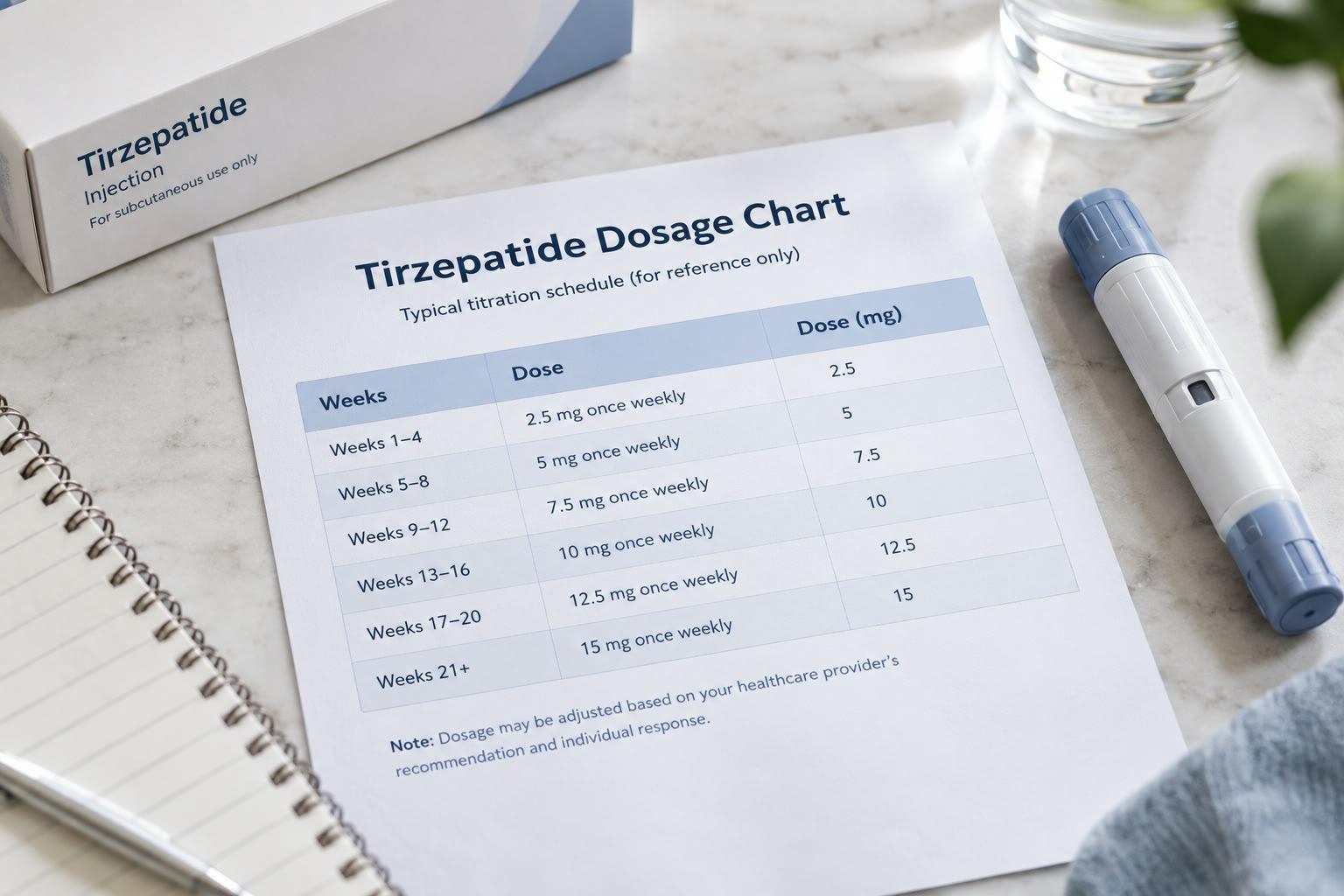
The Mounjaro® and Zepbound® dosing schedule from the FDA labels: the 2.5 mg start, the 2.5 mg steps, the maintenance doses, and what a missed dose means.
Tirzepatide is the active ingredient in Mounjaro® and Zepbound®, and both products share one dosing schedule. This chart restates that schedule from the FDA-approved labels, explains why it starts low and rises slowly, and says how compounded tirzepatide differs. It is a description of the labels, not a plan for you; your prescriber sets your dose.
What is the tirzepatide dosing schedule?
Treatment starts at 2.5 mg injected once a week. The label calls this a starting dose: it is there to let the body adjust, not to be a treatment dose. After four weeks the dose moves to 5 mg. From there, a prescriber may increase it by 2.5 mg at a time, with at least four weeks at each step, up to 15 mg a week.
| Step | Weekly dose | Minimum time at this step | Notes |
|---|---|---|---|
| 1 | 2.5 mg | 4 weeks | Starting dose; not intended as a maintenance dose |
| 2 | 5 mg | 4 weeks | First treatment dose; a maintenance dose on the Zepbound® label |
| 3 | 7.5 mg | 4 weeks | Step between maintenance doses |
| 4 | 10 mg | 4 weeks | Maintenance dose |
| 5 | 12.5 mg | 4 weeks | Step between maintenance doses |
| 6 | 15 mg | Ongoing | Maximum dose |
Why does tirzepatide start at 2.5 mg?
Tolerability. The side effects reported most often with tirzepatide are gastrointestinal, and they cluster in the early weeks and after each increase. Starting low and stepping up slowly gives the body time to adjust at each stage. Staying longer at a step, or going back down one, is a normal clinical decision and not a setback.
What is the maintenance dose of tirzepatide?
The Zepbound® label names 5 mg, 10 mg and 15 mg as maintenance doses, with 7.5 mg and 12.5 mg as the steps between them. The Mounjaro® label allows any dose from 5 mg to 15 mg as ongoing treatment. Which dose a person stays on is the prescriber's call, made from how the person is doing and how they tolerate treatment, not from a chart.
What if a tirzepatide dose is missed?
The labels say to take a missed dose as soon as possible within four days (96 hours) of when it was due, and otherwise to skip it and take the next dose on the usual day. Two doses should never be taken within three days of each other. The injection day can be changed as long as at least three days (72 hours) have passed since the last dose. If you take compounded tirzepatide, the pharmacy's and your clinician's instructions take precedence; message your care team rather than guessing.
What forms do the doses come in?
Mounjaro® and Zepbound® come in single-dose pens, one per strength, from 2.5 mg to 15 mg. Zepbound® is also sold in single-dose vials in several strengths for self-pay through the manufacturer. Compounded tirzepatide is usually supplied as a vial, with the dose drawn up in a syringe exactly as the pharmacy's instructions describe.
How does compounded tirzepatide dosing differ?
The molecule is the same, but a compounded preparation is made by a licensed compounding pharmacy for an individual patient, and the dose is set by the prescribing clinician rather than by a fixed pen strength. Compounded medications are not FDA-approved and are not reviewed by the FDA for safety, effectiveness, or quality. At GLP, the standard Tirzepatide Injections program steps the dose up on a schedule your clinician sets, and the Tirzepatide Microdose Injection stays below the standard schedule on purpose; the microdosing page explains what the evidence does and does not say about that.
This article is educational and is not a substitute for personalized medical advice. Whether any medication is appropriate for you is a decision for a licensed clinician who has reviewed your health history.