Comparisons
Wegovy® vs Zepbound®: what is the difference?
September 26, 2026 · 8 min read
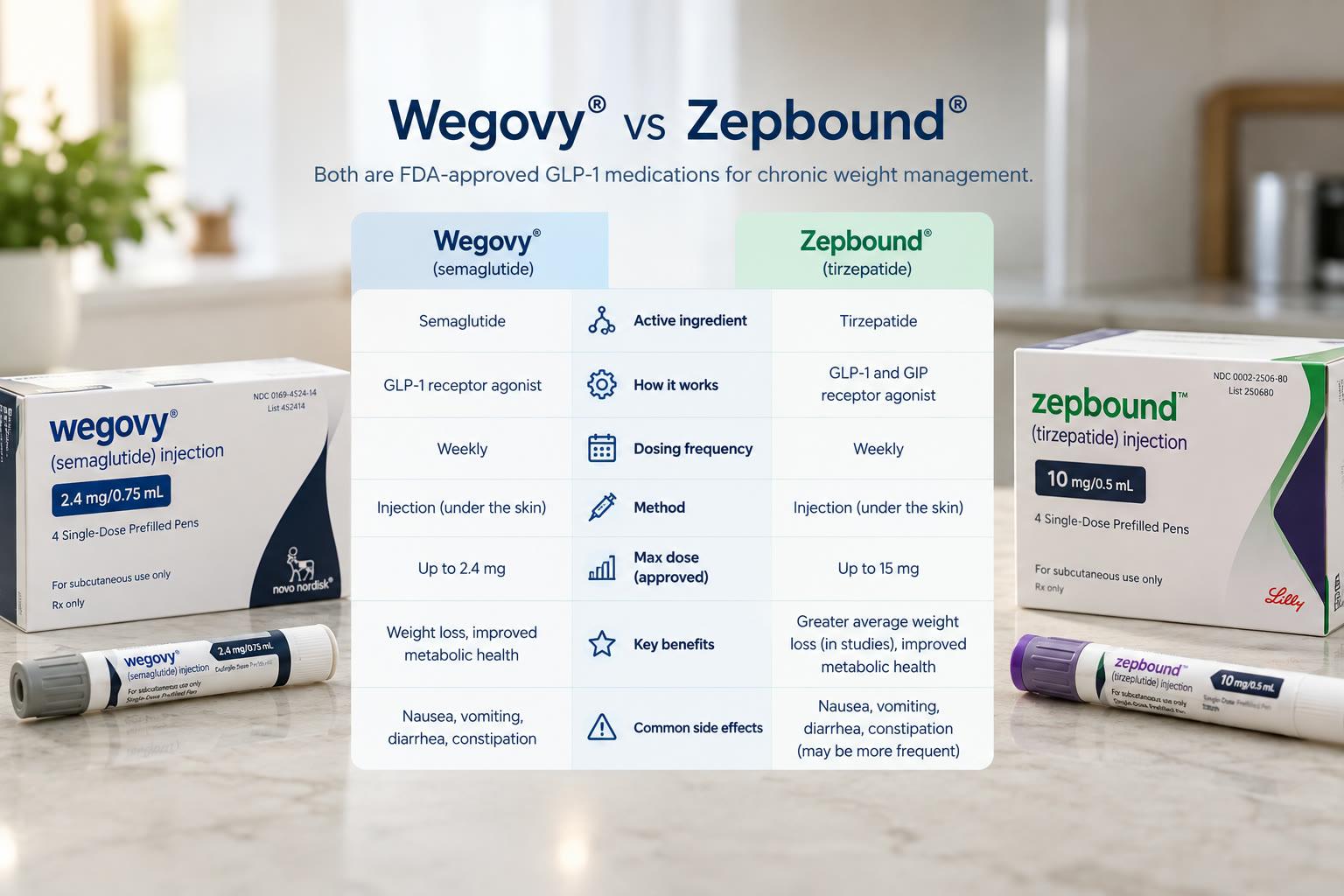
Two molecules from two manufacturers, both approved for chronic weight management: how Wegovy® and Zepbound® differ in dosing, approvals, forms and cost.
Wegovy® and Zepbound® are the two brand-name products approved for chronic weight management, and they are easy to lump together. They should not be: they contain different active ingredients, come from different manufacturers, and are dosed on different scales. This article sets them side by side from the FDA labels and approvals, without claiming one is better, because that is an individual clinical question.
What is the difference between Wegovy® and Zepbound®?
Wegovy® contains semaglutide, a GLP-1 receptor agonist, and is made by Novo Nordisk. Zepbound® contains tirzepatide, which acts on the GLP-1 pathway and on a second gut-hormone pathway, GIP, and is made by Eli Lilly. Wegovy® was approved in June 2021 for chronic weight management in adults with obesity, or with overweight and at least one weight-related condition; adolescents aged 12 and over were added in December 2022, and in March 2024 it was approved to reduce the risk of major cardiovascular events in adults with obesity or overweight and established heart disease. Zepbound® was approved for chronic weight management in November 2023, and in December 2024 for moderate-to-severe obstructive sleep apnea in adults with obesity.
| Wegovy® | Zepbound® | |
|---|---|---|
| Active ingredient | Semaglutide (GLP-1 receptor agonist) | Tirzepatide (GIP and GLP-1 receptor agonist) |
| Manufacturer | Novo Nordisk | Eli Lilly |
| FDA approvals | Chronic weight management (2021; adolescents 12+ from 2022); cardiovascular risk reduction (2024) | Chronic weight management (2023); obstructive sleep apnea in adults with obesity (2024) |
| How it is taken | Once-weekly injection under the skin | Once-weekly injection under the skin |
| Dose range | 0.25 mg to start, stepped to 2.4 mg a week | 2.5 mg to start, stepped in 2.5 mg increments to 15 mg a week |
| Forms | Single-dose pens | Single-dose pens; single-dose vials for self-pay |
| Self-pay route | NovoCare® Pharmacy (manufacturer) | LillyDirect (manufacturer) |
| Insurance | Coverage for weight management varies by plan | Coverage for weight management varies by plan |
How do they work differently?
Semaglutide mimics one gut hormone, GLP-1, which is involved in fullness signals and blood-sugar regulation. Tirzepatide mimics that hormone and a second one, GIP, which is why it is called a dual agonist. That is a real pharmacological difference, but it does not translate into a simple better-or-worse verdict for any individual; tolerability, medical history, other medications and what a clinician is treating all factor in.
How are they dosed?
Both start low and step up every four weeks. Wegovy® goes 0.25, 0.5, 1, 1.7 and 2.4 mg a week, with 2.4 mg as the maintenance dose. Zepbound® starts at 2.5 mg, moves to 5 mg after four weeks, and can rise in 2.5 mg steps to 15 mg. The milligram numbers are not comparable across the two molecules; a milligram of one is not a milligram of the other.
Which one works better?
The manufacturers have published trial results, including a head-to-head trial, and your clinician can tell you what they mean for someone with your history. This article does not quote them, because a trial average does not predict any one person's experience, and because which medication suits you depends on more than a comparison table.
Are the side effects similar?
Yes, in kind. Both labels list gastrointestinal side effects most often: nausea, diarrhea, vomiting, constipation and abdominal pain, mainly early in treatment and after dose increases. Both carry a boxed warning about thyroid C-cell tumors seen in animal studies and the same contraindications around medullary thyroid carcinoma and Multiple Endocrine Neoplasia syndrome type 2. One difference on the labels: tirzepatide can reduce how well oral birth control works around the start of treatment and after dose increases.
What do Wegovy® and Zepbound® cost?
Both carry manufacturer list prices of roughly a thousand dollars or more for a month's supply before insurance or savings programs. Both makers also sell directly for self-pay, Novo Nordisk through NovoCare® Pharmacy and Lilly through LillyDirect, at prices in the hundreds of dollars a month that have changed several times since 2024; check the manufacturers' sites for current figures. What a person actually pays depends on coverage.
Which would a clinician prescribe?
It depends on the person: history, other medications, tolerability, and what is being treated. GLP's clinicians do not prescribe either brand. If a program is prescribed through GLP, the medication is compounded semaglutide or compounded tirzepatide, the same active ingredients prepared by a licensed compounding pharmacy for an individual patient. Compounded medications are not FDA-approved and are not reviewed by the FDA for safety, effectiveness, or quality.
This article is educational and is not a substitute for personalized medical advice. Whether any medication is appropriate for you is a decision for a licensed clinician who has reviewed your health history.
Frequently asked questions
Related
Sources
- FDA: approval of Wegovy® for chronic weight management (June 2021)
- FDA: Wegovy® approved to reduce cardiovascular risk (March 2024)
- FDA: approval of Zepbound® for chronic weight management (November 2023)
- FDA: approval of Zepbound® for obstructive sleep apnea (December 2024)
- Wegovy® prescribing information
- Zepbound® prescribing information
- NovoCare® Pharmacy: manufacturer self-pay pricing for Wegovy®
- LillyDirect: manufacturer self-pay pricing for Zepbound®