Microdosing
Microdosing tirzepatide: what is known and what isn't
October 2, 2026 · 7 min read · Medically reviewed by Bryan Milton, MD · Reviewed October 2, 2026
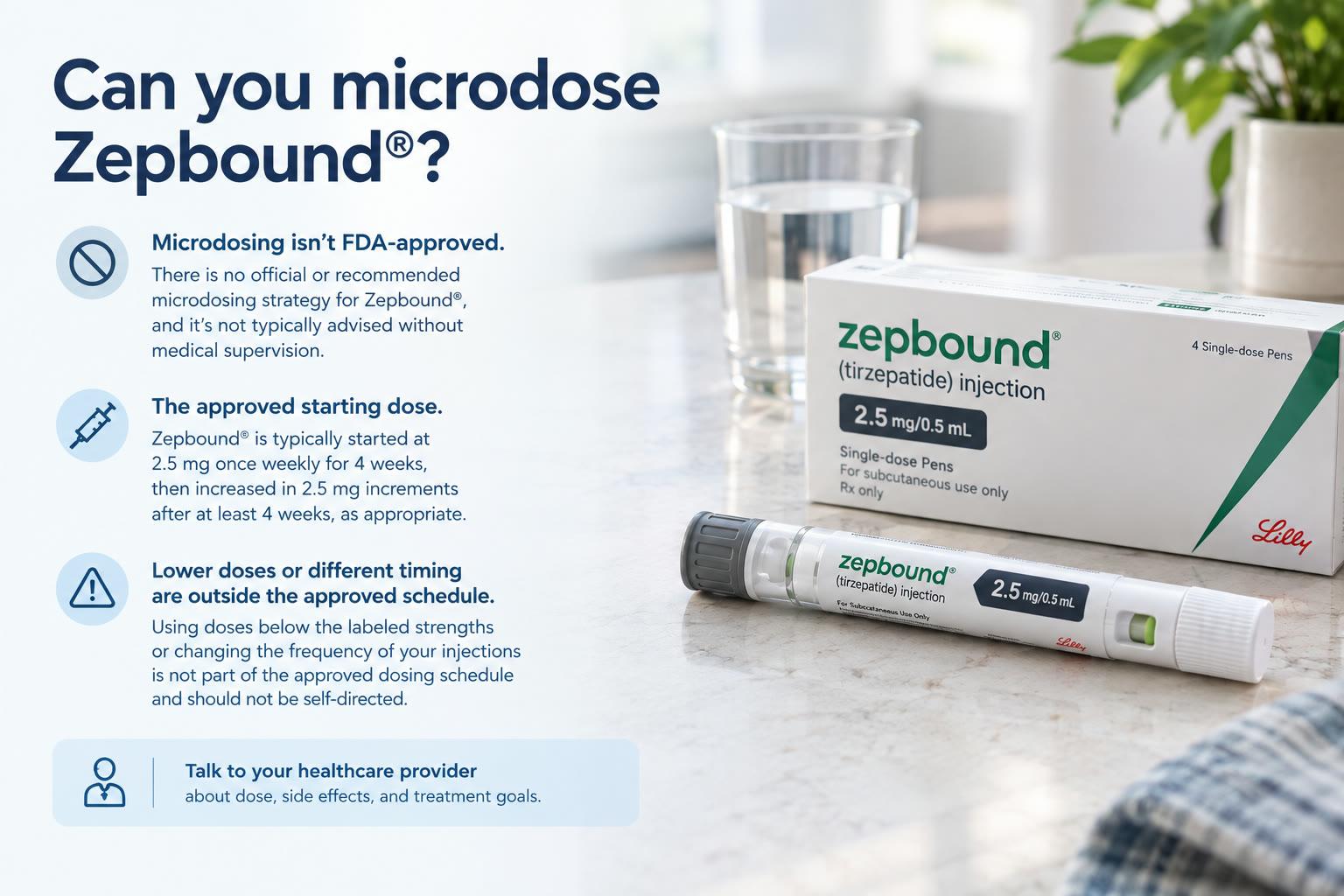
Tirzepatide's approved schedule climbs in 2.5 mg steps toward a maintenance dose. What holding below that schedule does and does not have evidence behind it.
Microdosing tirzepatide means holding a weekly dose below the standard maintenance schedule rather than titrating up to it. The question people are really asking is whether a smaller amount of a drug that acts on two hormone pathways can do enough. The honest answer is that it is plausible, individual, and not established by trial evidence.
What is the standard tirzepatide schedule?
The approved labels start at 2.5 mg once weekly for four weeks — a starting dose, not a treatment dose — then step up in 2.5 mg increments at intervals of at least four weeks, toward a maintenance dose in the higher part of the range. The label also tells prescribers they can hold a step when the current dose is not being tolerated.
Microdosing a GLP-1 means staying on a dose below the standard maintenance schedule rather than stepping up to it. The approved products were studied on a titration schedule that rises over several weeks to a target dose; a microdose program holds below that, at a level a licensed clinician sets and adjusts.
Does microdosing tirzepatide work?
Lower-than-standard dosing has not been studied the way the approved schedule has. The published trials tested the titration schedules on the FDA-approved products' labels, so their results describe those regimens — not a lower dose, and not a compounded preparation.
The specific reason tirzepatide comes up more often than semaglutide in this conversation is mechanism: it acts on the GLP-1 receptor and on the GIP receptor, where semaglutide acts on one. From that, people infer that less of it should go further. That inference is reasonable to raise with a clinician and is not a finding. Acting on two pathways is a real pharmacological difference; it does not translate into a dose-equivalence rule, and no study has tested one.
Is a lower dose easier to tolerate?
Often, but not reliably, and the mechanism is not mysterious: the labelled side effects cluster in the early weeks and after each step up, so someone who never takes a step up never meets that particular trigger. What does not change is the rest of the safety picture. The boxed warning about thyroid C-cell tumors seen in animal studies applies at any dose, as do the contraindications, the cautions around pancreatitis and gallbladder disease, and the label's note that tirzepatide can reduce how well oral contraceptives are absorbed around the start of treatment and after each dose increase.
- Side effects can occur at any dose; a smaller amount is not a guarantee of fewer.
- Screening matters as much at a low dose as at a high one — the contraindications are about you, not about the amount.
- Tell your clinician everything you take, including oral contraceptives, whatever dose is being considered.
- Report anything unexpected to your care team rather than deciding it must be too small a dose to matter.
Who is a lower-dose tirzepatide program for?
Most often, someone who did not get past a step on the standard schedule, or who responded at a low step and does not see a reason to keep climbing. Sometimes someone who wants to spend less, which is a fair thing to raise. It is not for someone whose reason for treatment depends on the evidence behind the studied schedule — and a clinician weighing that should say so plainly rather than accommodate the request.
How is the dose set at GLP?
A licensed clinician reviews your assessment and decides whether a lower-dose program is appropriate, whether the standard program fits better, or whether treatment is not indicated. If a microdose is prescribed, the medication is compounded tirzepatide as a once-weekly injection, at a dose your clinician sets, holds and adjusts from your check-ins. Compounded medications are not FDA-approved and are not reviewed by the FDA for safety, effectiveness, or quality.
This article is educational and is not a substitute for personalized medical advice. Whether any medication is appropriate for you is a decision for a licensed clinician who has reviewed your health history.