Cost & access
What drives the cost of GLP-1 care without insurance
October 2, 2026 · 7 min read · Medically reviewed by Bryan Milton, MD · Reviewed October 2, 2026
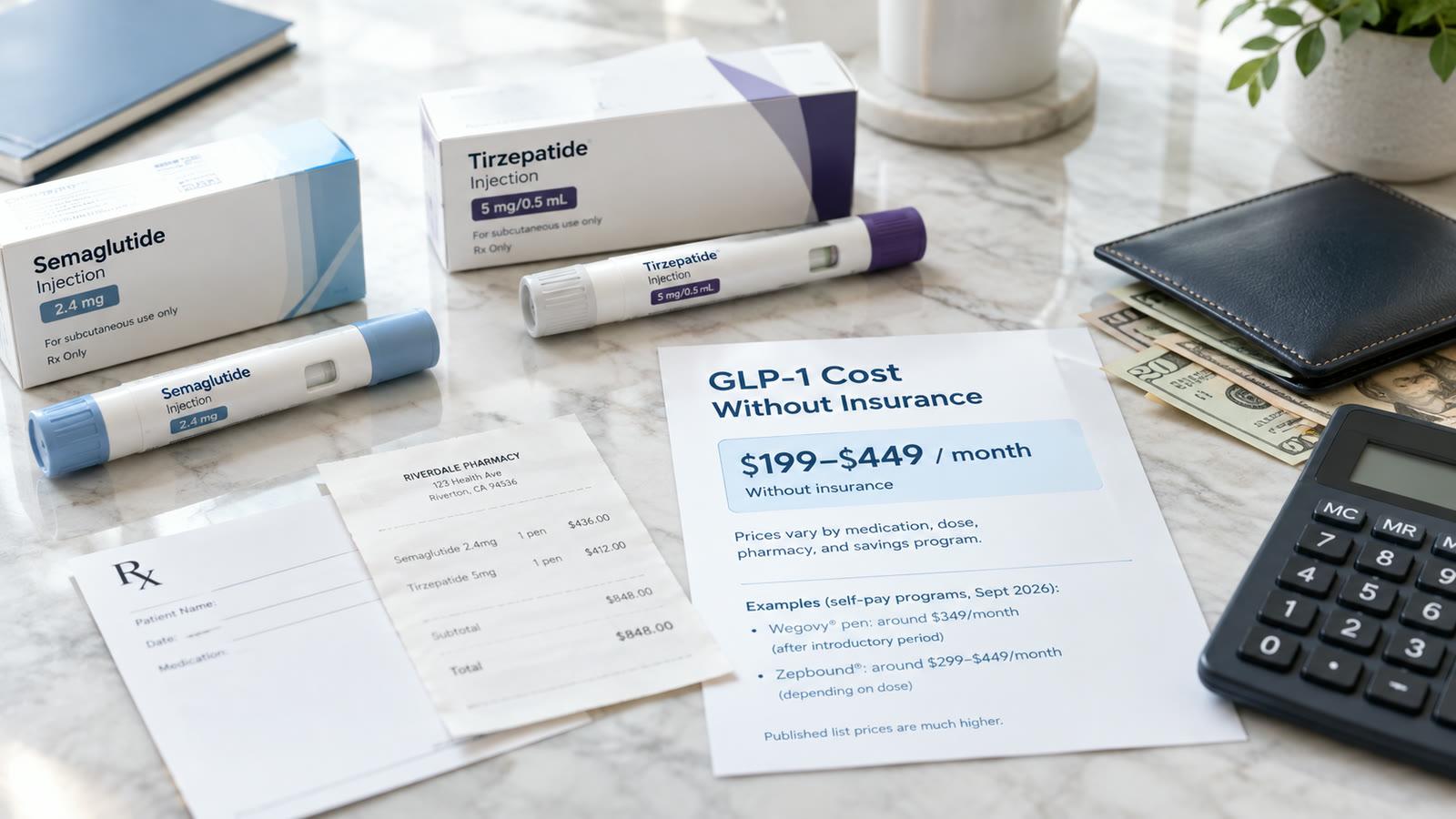
Cash-pay GLP-1 prices vary widely for reasons that are mostly knowable. What moves the number, and the five questions that reveal the real total.
GLP-1 pricing without insurance is genuinely confusing, and not by accident: the same molecule can cost very different amounts depending on the route, the dose and what is bundled in. Most of the variation is explainable, which means you can work out what you are actually being quoted.
The routes, and why they differ
| Route | What drives the price |
|---|---|
| Brand-name product through insurance | Your plan's formulary, tier and deductible — often the cheapest when covered, and frequently not covered for weight management |
| Brand-name product at self-pay prices | Manufacturer self-pay programs and pharmacy pricing; these change, so check at source |
| Compounded preparation through a cash-pay service | The pharmacy's preparation, the amount dispensed, and what the service bundles in |
| Unlicensed 'research' sellers | Cheapest and not a medical route at all — no prescription, no pharmacy, no accountability |
This article does not quote prices for the first two routes. Manufacturer self-pay programs and insurance policy have changed repeatedly, and a dated figure is worse than none — check the manufacturer's own site and your plan's formulary for the current position.
What moves the number within a route
- The molecule. Semaglutide and tirzepatide preparations are not priced the same.
- The dose. More medication costs more, which is why a lower-dose program is cheaper.
- The form. Injection and oral preparations differ in cost.
- What is bundled. Clinician review, check-ins, messaging and shipping are either included or extra.
- The billing period, which is where quoted prices most often mislead.
The billing-period trap
A price quoted 'per month' and a price quoted 'per 4 weeks' are not the same price. There are thirteen 4-week cycles in a year and twelve months. A 4-week price is therefore about 8% more per year than the same number billed monthly. Neither is dishonest; conflating them is. When you compare two services, convert both to an annual figure before deciding anything.
GLP states its prices per 4 weeks for this reason, on each program's page and confirmed before you pay.
The five questions
A headline price is only useful if you know what it includes. These are the five questions that turn a quoted figure into a real one, and the places a cash-pay GLP-1 price most often stops being what it appeared to be.
- Is the medication included in this price, or billed separately?
- Is the clinician review included, or is there a consultation fee?
- Is shipping included?
- Is this per month or per 4 weeks — and what is the annual total?
- What happens to the price if my dose changes?
A sixth worth adding: what is the cancellation notice period? That determines whether deciding to stop costs you one more cycle.
What GLP charges
One price per program per 4 weeks, shown on the program page and confirmed before you pay. The microdosing program is the lowest-priced; the weight-management program is priced per product. Cash-pay: no insurance, no claims, no paperwork. No contracts — cancel with 72 hours' notice before your next billing date. Free tracked shipping in plain packaging. Exactly what the price does and does not cover, including the medication, is shown before you pay. Compounded medications are not FDA-approved and are not reviewed by the FDA for safety, effectiveness, or quality.
Why the cheapest option is not always cheapest
Two reasons. A price that excludes the medication, the consultation or shipping is not comparable to one that includes them. And the genuinely cheapest sellers — the unlicensed ones — are not cheaper versions of the same thing: no prescription, no identifiable pharmacy, no screening and nobody monitoring you. That is covered in the article on gray-market peptides.
This article is educational and is not a substitute for personalized medical advice. Whether any medication is appropriate for you is a decision for a licensed clinician who has reviewed your health history.