GLP-1 medications
Can you microdose Ozempic®?
September 25, 2026 · 7 min read
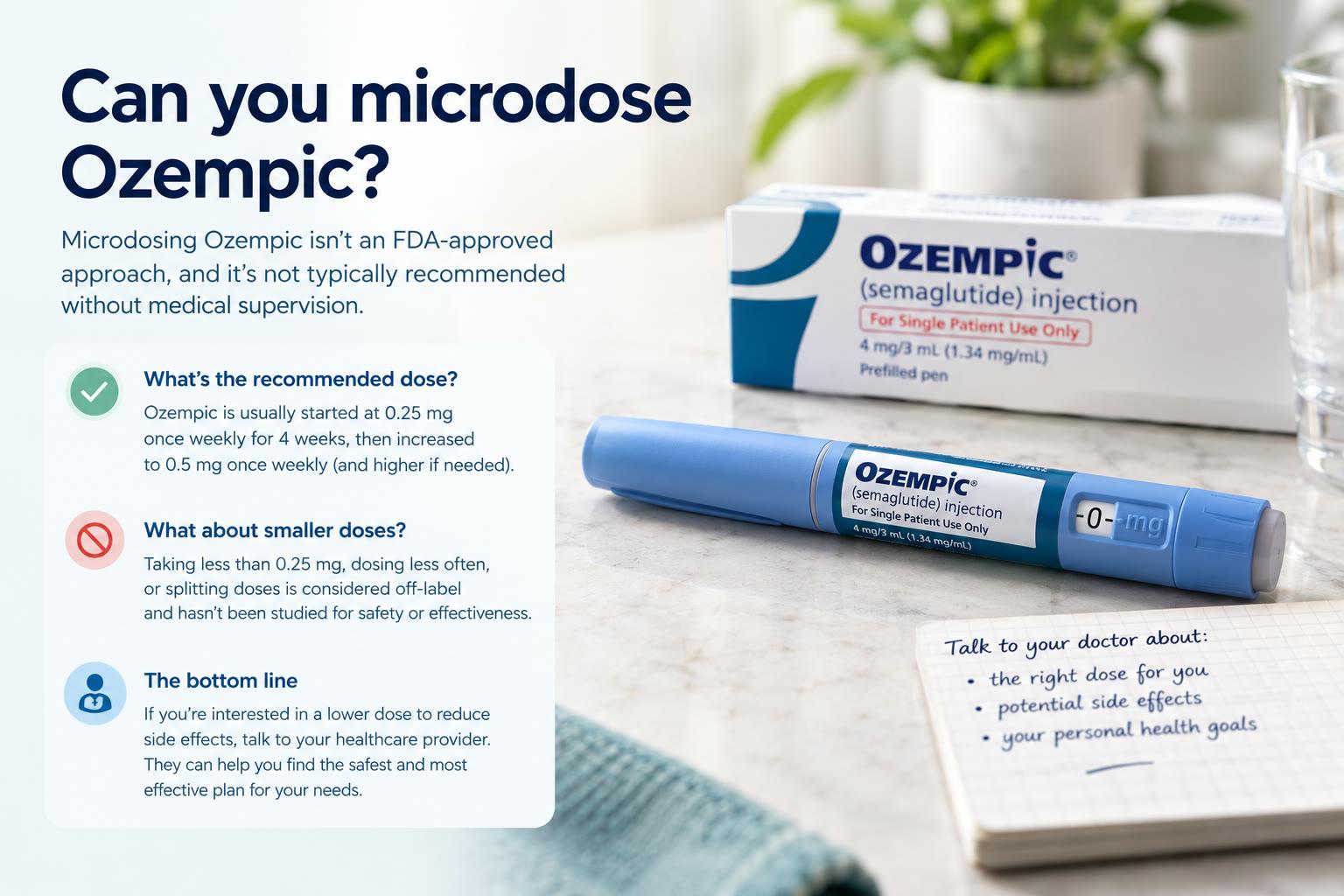
What people mean by microdosing Ozempic®, why the pen makes it hard, what the evidence says, and what a lower-dose program looks like instead.
"Microdosing Ozempic®" is one of the most searched phrases around GLP-1 medications, and one of the least defined. This article explains what people mean by it, why the product itself gets in the way, what the evidence does and does not say, and what a lower-dose program looks like when a licensed clinician is involved.
What does microdosing Ozempic® mean?
Ozempic® is approved by the FDA to improve blood sugar control in adults with type 2 diabetes. Its label starts everyone at 0.25 mg once a week for four weeks, then moves to 0.5 mg, with 1 mg and 2 mg available if more is needed. "Microdosing" is the everyday term for staying below that schedule on purpose: holding at the 0.25 mg starting dose, taking an amount smaller than any labelled dose, or spacing injections further apart.
It is worth saying plainly that using Ozempic® for weight management at all is off-label; Wegovy® is the semaglutide product approved for that. Microdosing adds a second departure from the label on top of the first.
Why is the Ozempic® pen a problem for microdosing?
The Ozempic® pen is a multi-dose device with a dial designed to deliver its set doses. People who microdose it count the clicks of the dial to stop short of a full dose. That is not a use the manufacturer describes or endorses, the accuracy of a partial dial turn is not something the product was tested for, and it is not something to work out from a video. If a prescriber has a reason to want a lower dose, the conversation belongs with them.
Is there evidence that microdosing Ozempic® works?
No. The trials behind semaglutide studied the labelled schedules: 0.5 mg to 2 mg a week for type 2 diabetes, and the Wegovy® schedule up to 2.4 mg a week for weight management. Lower-than-labelled dosing for weight management has not been studied in clinical trials, and the hospital systems and pharmacists who have written about the trend say the same thing: what exists is anecdote, not evidence.
What are the risks of microdosing Ozempic®?
Side effects can occur at any dose. The most commonly reported ones are gastrointestinal: nausea, vomiting, diarrhea, constipation and abdominal pain. The class warnings, including the boxed warning about thyroid C-cell tumors seen in animal studies, and the contraindications, such as a personal or family history of medullary thyroid carcinoma or Multiple Endocrine Neoplasia syndrome type 2, do not go away at a smaller dose. Two further risks are specific to the practice: dosing a pen in a way it was not designed for, and buying semaglutide from sources that are not licensed pharmacies.
What does a lower-dose program look like with a clinician?
GLP's clinicians do not prescribe Ozempic® or any brand-name product. What GLP offers instead is a microdosing program: you complete a free assessment, and a licensed clinician decides whether a lower-dose program is appropriate, whether a standard program fits better, or whether treatment is not indicated. If a microdose is prescribed, it is compounded semaglutide at a dose the clinician sets and adjusts from your check-ins, dispensed by an independent, licensed U.S. pharmacy. Compounded medications are not FDA-approved and are not reviewed by the FDA for safety, effectiveness, or quality. The same evidence limits apply: a lower dose has not been studied the way the standard schedule has, and the program is presented as what it is.
Who should not consider it?
Anyone with a contraindication to GLP-1 medications, anyone who is pregnant, planning a pregnancy or breastfeeding, and anyone who needs standard treatment for a diagnosed condition such as type 2 diabetes, which should be managed with the clinician who treats it. The assessment exists to screen for exactly these, and a clinician can say no.
This article is educational and is not a substitute for personalized medical advice. Whether any medication is appropriate for you is a decision for a licensed clinician who has reviewed your health history.